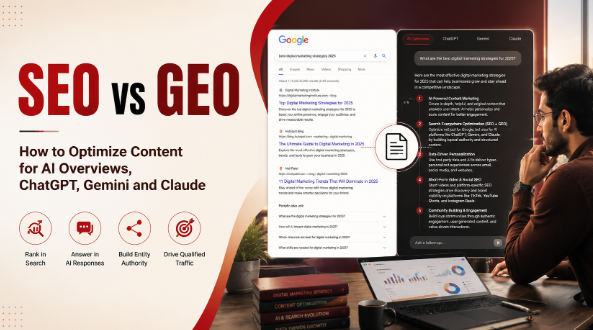
SEO gets a page ranked inside Google’s list of blue links. GEO, short for Generative Engine Optimisation, gets that same page picked up and quoted inside an AI answer on ChatGPT, Gemini, Claude, Perplexity or Google AI Overviews. AEO sits between the two and targets the short answer box. The gap between them is no longer a theory. Google users clicked a normal search result in only 8% of visits when an AI summary appeared, against 15% of visits when no summary showed (Pew Research Center, July 2025). That is why the top 10 GEO companies in India now write every page for two readers at once: general users, and the language model that will summarise it.
One question that often comes up in client meetings is a blunt one. If AI now answers everything, is SEO finished? The short reply is no. The traffic has not vanished. It has changed shape.
The situation has changed considerably over the last two years. Gartner said in February 2024 that traditional search volume would fall by 25% by 2026 as chatbots and virtual agents took over. Search did not shrink that far. What did change is how people read a results page, and how often they bother to click at all.
What is Search Engine Optimisation (SEO)?
Search Engine Optimisation (SEO) is the practice of shaping a website so search engines can crawl it, understand it and rank it.
It has three working parts. Technical SEO keeps pages fast, clean and easy to crawl. On-page SEO covers titles, headings, keyword placement and internal links. Off-page SEO builds links and mentions from other websites.
The prize is a click. A person types a query, scans the results, and picks one. SEO decides whose link that is.
What is Generative Engine Optimisation (GEO)?
Generative Engine Optimisation (GEO) is the work of getting a brand named, quoted and linked inside AI-written answers. There is no list of ten links inside a ChatGPT reply. There is one paragraph, a few source links, and nothing else.
That single change rewrites the scoreboard. Ranking well still helps, because most AI systems pull from indexed pages. Being quotable now matters just as much. Researchers from Princeton, IIT Delhi, Georgia Tech and the Allen Institute for AI tested nine content changes across 10,000 queries and found that adding statistics, quotations and named citations lifted a page’s visibility inside generative engines by up to 40%.
Agencies working as GEO agencies build this habit into the first draft. The top 10 GEO companies in India treat a sourced number as a ranking asset, not a footnote.
What is Answer Engine Optimisation (AEO) ?
Answer Engine Optimisation (AEO) targets the short, direct reply. Featured snippets, People Also Ask boxes, and the spoken answer that comes back from Google Assistant or Siri.
AEO asks one thing on a page. Can it answer a real question in two clean sentences, with no run-up?
In practice, AEO sits inside GEO. Every AEO habit helps GEO. Not every GEO habit is needed for AEO.
How does GEO differ from traditional SEO?
Both need the same foundation: a crawlable site, honest writing and real authority. They part company on what counts as a win.
| What changes | SEO | GEO | AEO |
| Main target | Ten blue links on Google | Answers inside ChatGPT, Gemini, Claude, Perplexity and AI Overviews | Featured snippets, People Also Ask, voice replies |
| Unit of success | Ranking position | Citation and brand mention | Owning the answer box |
| Shape of the content | Long pages built around a keyword | Short, fact-dense blocks a model can lift cleanly | One question, one tight answer |
| Signals that help most | Backlinks, page speed, keyword match | Statistics, quotes, named sources, plain wording | Question headings, 40 to 60 word answers |
| How it is measured | Rank, clicks, impressions | Share of AI answers, citations, referral visits | Snippet count, voice pick-up |
GEO does not replace SEO. It runs on top of it. That is the working method behind the best AI SEO agencies in India, and behind most firms described as GEO companies.
How the Top 10 GEO Companies in India Prepare Content for AI Search Engines
Four habits carry most of the weight.
Answer the question inside the first 150 words
AI systems read the top of a page first. If the answer sits in paragraph nine, it may never be read at all. State the answer, then explain it.
How the top 10 GEO companies in India use real numbers and named sources
Vague claims get skipped. Specific ones get quoted. This is the strongest finding in the academic work on GEO so far.
| Change made to the page | Reported lift in AI visibility |
| Adding citations from named, credible sources | About 30% to 40% |
| Adding relevant statistics in place of vague claims | About 30% to 40% |
| Adding quotations from credible voices | About 30% to 40% |
| Improving fluency and plain readability | About 15% to 30% |
| Stuffing keywords into the copy | No reliable gain, and sometimes a loss |
Write plainly enough for a school student to follow
The same study found that making a page easier to read raised its visibility by 15% to 30%, with no new facts added at all. Dense writing works against the source, even when the information behind it is sound.
Technical basics the top 10 GEO companies in India check first
Clean HTML, one H1 per page, a logical heading order, fast loading, correct schema markup, and a robots.txt file that does not block AI crawlers by accident. If a page, a model cannot parse, will never be quoted, however good the writing is.
What are the benefits of GEO?
The clearest benefit is being present where the questions are now being asked. India is the second-largest ChatGPT market in the world, with about 100 million weekly active users as of February 2026. India also became the world’s largest market for generative AI app downloads in 2025, with installs up 207% year on year.
| What the data shows | Figure | Period | Source |
| Weekly active ChatGPT users in India | About 100 million | Feb 2026 | OpenAI, via TechCrunch |
| India’s share of users of leading AI assistant apps | About 19%, ahead of the United States at 10% | 2025 | Sensor Tower |
| Growth in generative AI app installs in India | Up 207% year on year | 2025 | Sensor Tower |
| US Google searches that end without any click | About 68% | Early 2026 | SparkToro and Similarweb |
| Click-through drop for the top-ranked page when an AI Overview appears | 34.5%, later measured at 58% | Mar 2025 to Dec 2025 | Ahrefs, 300,000 keywords |
| Share of AI referral traffic sent by ChatGPT | About 74.8%, Gemini 11.6%, Perplexity 7.2% | 2026 | SE Ranking |
Set against those numbers, the gains from GEO are practical ones:
● Visibility that survives zero-click search, where the reader never leaves Google.
● Better quality visits, because the reader arrives after the brand has already been compared against others.
● Brand recall from a mention, even when no click follows.
● One page that works across Google, ChatGPT, Gemini, Claude and Perplexity at the same time.
● Cleaner SEO as a side effect, since both reward good structure and honest sources.
This is the shared ground between AI SEO companies and classic search teams. The top 10 GEO companies in India are usually doing both jobs under one roof.
How SEO and GEO help to promote branding
A citation inside an AI answer reads like a recommendation from a neutral party. The reader has not picked the brand off a list. A machine has selected it out of the whole web and named it. That carries a different weight from a paid ad.
SEO builds the ground floor: pages that exist, load fast and cover the subject properly. GEO builds the roof: sourced facts, plain answers and clean structure a model can lift. Run together, they put a brand in front of a buyer twice, once in the search results and once in the AI answer sitting above them.
For a smaller firm this matters more, not less. SEO companies for small business used to compete on backlinks and budget alone. Inside an AI answer, a well-sourced page from a small brand can sit beside a very large one.
Conclusion
GEO is not a replacement for SEO. It is the next layer on the same wall. Businesses drawing up a shortlist of the top 10 GEO companies in India are not walking away from rankings. They are asking one extra question of every page: if a language model reads this, will it quote us?
Digital Reach works on both sides of that question, from technical SEO and content production to Generative Engine Optimisation, performance marketing and web development. The method is plain. Get the basics right, put real numbers on the page, write it so a person can follow it, and let the machines do the rest.
Frequently Asked Questions
What is the difference between GEO and SEO?
SEO works to rank a page inside Google’s list of links. GEO works to get that page quoted inside an AI-written answer on ChatGPT, Gemini, Claude, Perplexity or Google AI Overviews. SEO is measured by rank and clicks. GEO is measured by citations and brand mentions.
Does GEO replace SEO?
No. GEO sits on top of SEO. AI systems mostly draw from pages that are already indexed and ranking, so a weak SEO base limits GEO results. The two run together, which is why most GEO agencies also handle technical SEO and content.
How do the top 10 GEO companies in India measure GEO results?
They track how often a brand appears inside AI answers for a set list of prompts, which sources get cited alongside it, and how much referral traffic arrives from ChatGPT, Gemini, Perplexity and Copilot. Rankings are still tracked, but they sit beside citation shares.
Which AI platforms matter most for Indian brands?
ChatGPT sends the largest share of AI referral traffic, around 74.8% in 2026, with Gemini second at about 11.6% (SE Ranking). Gemini matters heavily in India because it comes pre-installed on most Android phones, so both deserve attention.
How long does GEO take to show results?
It varies by sector and by how strong the existing site is. Pages need to be crawled, indexed and then picked up by AI systems, so a fair review window is three to six months. Well-sourced pages on an established domain usually move faster.
Can a small business afford GEO?
Yes. The work that matters most costs writing time rather than media spend: answer the question early, add real statistics, name the sources, keep the wording simple and fix the technical basics. That is why best AI SEO agencies 2026 shortlists now include smaller specialist firms.
Sources
1. Pew Research Center, “Google users are less likely to click on links when an AI summary appears in the results”, July 2025: the 8% versus 15% click figures. https://www.pewresearch.org/short-reads/2025/07/22/google-users-are-less-likely-to-click-on-links-when-an-ai-summary-appears-in-the-results/
2. Gartner press release, February 2024: the prediction that traditional search engine volume would drop 25% by 2026. https://www.gartner.com/en/newsroom/press-releases/2024-02-19-gartner-predicts-search-engine-volume-will-drop-25-percent-by-2026-due-to-ai-chatbots-and-other-virtual-agents
4. Search Engine Land coverage of the GEO research paper: a plain-language summary of the same study. https://searchengineland.com/generative-engine-optimization-framework-introduced-research-paper-435855
5. Ahrefs, “AI Overviews Reduce Clicks by 34.5%”: the 300,000 keyword click-through study. https://ahrefs.com/blog/ai-overviews-reduce-clicks/
6. Ahrefs 2026 update, reported May 2026: the revised 58% click-through drop using December 2025 data. https://www.businesswire.com/news/home/20260518322756/en/New-Research-Googles-AI-Overviews-Now-Cost-Websites-58-of-Their-Clicks
10. SE Ranking AI traffic research study, 2026: ChatGPT at 74.78%, Gemini at 11.56% and Perplexity at 7.23% of AI referral traffic. https://seranking.com/blog/ai-traffic-research-study/